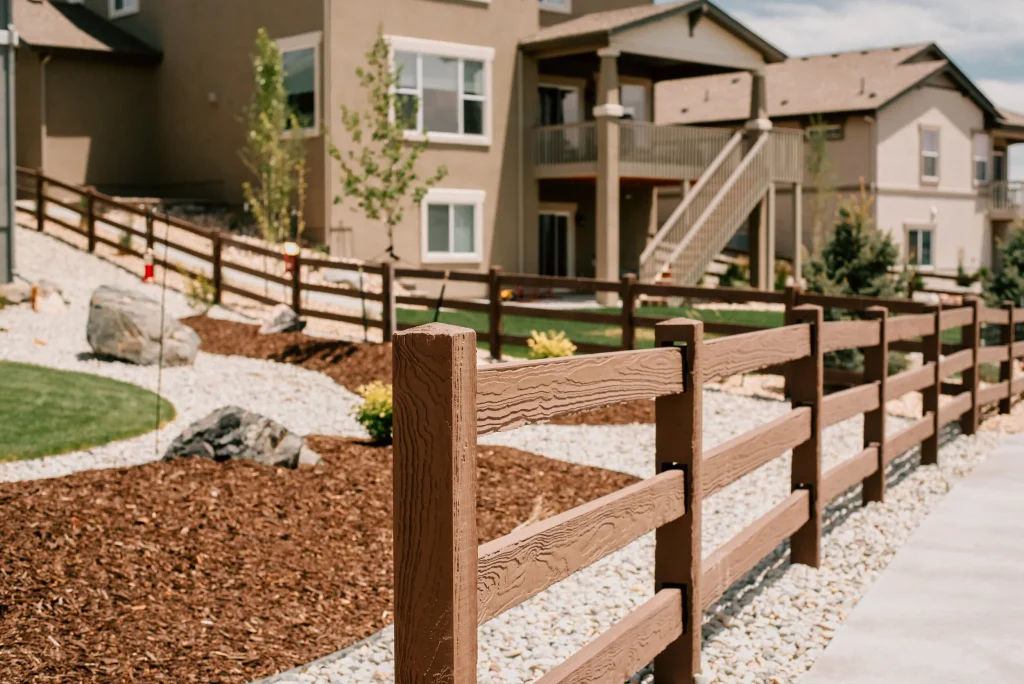
For contractors, builders and architects in Southern California, sustainability, energy efficiency, and wildfire resilience have become increasingly important when choosing building materials. Timbercrete is one an amazing material gaining attention for its performance, environmental benefits, and suitability for the local climate, and is being used more and more for projects in Moorpark and the greater Southern California region.
What Is Timbercrete?
Timbercrete is a concrete building material made from a blend of steel and fiber reinforced concrete, creating a fencing material with a deep natural wood grain texture that result is lightweight, durable and attractive, offering improved sustainability and thermal performance.
Unlike traditional wood or mason building materials, it incorporates reclaimed wood fibers that would otherwise end up in landfills. When used for fences and privacy walls, timbercrete provides the solidity of masonry without many of the drawbacks of traditional concrete or wood fencing.
Why Use Timbercrete for Fences & Privacy Walls in Southern California?
Excellent for Moorpark’s Climate
Timbercrete performs well in Southern California’s warm, dry conditions. Unlike wood fencing, it does not warp, rot, or degrade due to sun exposure. Its mass also helps reduce heat transfer, making it ideal for perimeter and privacy applications around homes and commercial properties to help regulate temperatures.
Superior Noise Reduction
For projects near roads, neighboring properties, or commercial zones, timbercrete privacy walls offer improved sound attenuation compared to standard wood or vinyl fences. This is another reason so many home owners and HOAs in Moorpark have opted to install fences and privacy walls with it.
Long-Term Durability
Timbercrete walls are resistant to:
- Moisture damage
- Pests and insects
- Rot and decay
This durability significantly reduces long-term maintenance compared to traditional fencing materials.
Timbercrete vs. Traditional Fence Materials
When compared to common fence and wall options:
- Wood fences require frequent maintenance and have limited lifespan.
- Vinyl fencing lacks structural mass and sound control.
- Concrete block walls are durable but heavier and less insulating, as well as less attractive to look at.
Timbercrete privacy walls combine the strength of masonry with improved thermal and acoustic performance, while supporting sustainable construction goals. With the option to add color, the visual aesthetics are the icing on the cake.
Fire Resistance & Safety
Fire resistance is a critical concern in Southern California. Timbercrete is non-combustible and engineered to meet fire-resistance standards similar to concrete masonry. The recycled timber content is fully encapsulated within the cement matrix, meaning it does not behave like exposed wood during a fire event.
For perimeter walls and fences in wildfire-prone areas, it provides an added layer of safety over traditional wood fencing. Timbercrete meets Fire Resistance Requirements in ALL Forestry Defendable Space Zones.
Applications for Builders & Architects
Timbercrete is well suited for:
- Residential privacy walls
- Perimeter and boundary fences
- Sound walls for residential developments
- Commercial property enclosures
- Multi-family and mixed-use projects
Its clean, solid appearance can be finished or detailed to complement modern and traditional architectural styles.
Timbercrete Fence & Privacy Wall Solutions in Moorpark
For builders and architects working in Moorpark and greater Southern California, timbercrete offers a durable, sustainable solution for fencing and privacy wall systems. As demand grows for low-maintenance, fire-resistant materials, it is becoming an increasingly relevant choice.
Timbercrete fences and privacy walls provide a durable, fire-resistant, and sustainable alternative to traditional fencing materials—well suited for Southern California construction.
Timbercrete is used for residential, commercial, and light industrial construction. Common applications include exterior and interior walls, multi-family housing, ADUs, and sound walls.
Timbercrete can be used in California construction when it meets applicable building codes and engineering requirements. Builders and architects should verify local approvals and specifications for their specific project.
Yes. Timbercrete is non-combustible and designed to meet fire-resistance standards similar to traditional concrete masonry. The timber content is encapsulated within the cement matrix and does not burn.
Yes. Timbercrete performs well in Southern California’s warm, dry climate and helps improve energy efficiency by stabilizing indoor temperatures.